Does home insurance cover a leaking roof?
Usually only when something sudden caused it, most often a storm. Buildings insurance normally covers storm damage, but policies exclude wear and tear, lack of maintenance and damage that builds up slowly. A roof that leaks because it has worn out is usually treated as upkeep, not a claim. Your own policy wording decides it.
What home insurance usually pays for on a roof
Storm damage. The Financial Ombudsman Service, which settles disputes between customers and financial firms, says buildings insurance policies usually cover financial loss caused by storm damage.
So if a gale lifts tiles off a sound roof and rain comes in through the gap that night, that is the kind of claim a standard policy is written for. The roof is part of the building, so damage to it goes on buildings cover. Damage to carpets, furniture and belongings falls under contents cover, if you have it.
What a policy pays for is a list of named events, and every policy has its own list. Read yours before you assume anything.
What it usually does not pay for
Wear and tear, and damage that happens slowly. The first direct home insurance policy document, for example, says the policy does not cover loss or damage caused by wear and tear or a lack of maintenance, and names checking for missing or slipped tiles and keeping gutters and downpipes clear as basic upkeep.
The Financial Ombudsman Service explains why. If it agrees with an insurer that the damage was caused by wear and tear, it is unlikely to tell the insurer to pay, because everything wears out eventually and insurance cannot protect you from that.
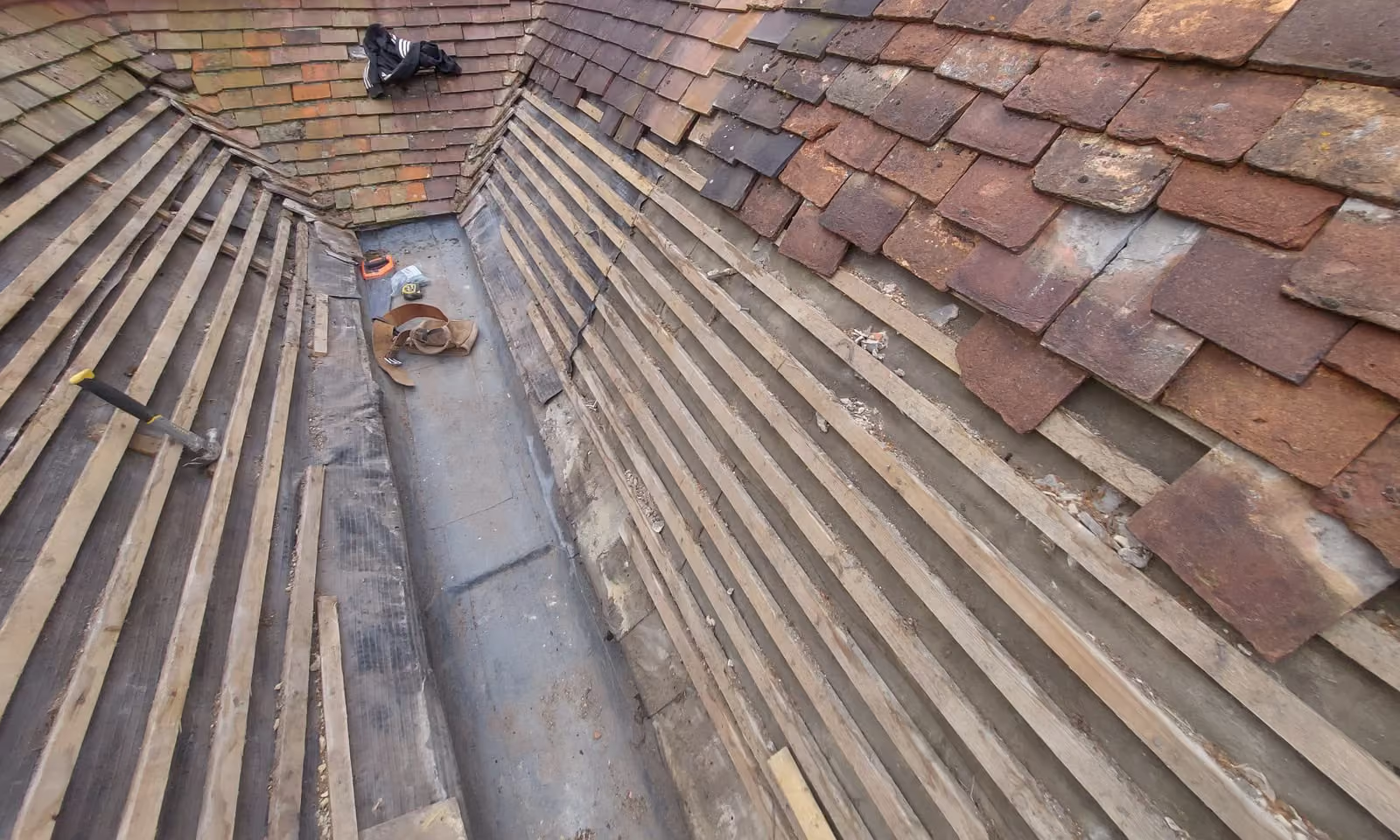
On a roof, that means the slow failures behind a lot of leaks: ridge mortar that has crumbled out over years, lead flashing that has split with age, a flat roof covering at the end of its life, or felt that has perished under the tiles. None of those is a sudden event.
Some policies spell the roof out. Homeprotect's policy booklet says a roof must be reasonably maintained, with no significant wear, leaks or missing tiles that could lead to further damage.
When a storm hits a roof that was already tired
This is where many disputes start. The Association of British Insurers says stormy weather sometimes reveals existing weak spots rather than causing new damage, and that insurers assess whether the storm was the direct cause or simply exposed areas already in need of repair. The first direct wording puts it more bluntly: a storm can highlight defects rather than cause them.
When a storm claim is turned down and the customer complains, the Financial Ombudsman Service asks three questions. Were there storm conditions on or around the date of the damage? Is the damage consistent with what it generally sees as storm damage? Was the storm the main cause, or were there other factors that meant the damage might have happened anyway?
A roof does not have to be perfect. The ombudsman says a property that was clearly not in perfect condition before a storm does not automatically mean the damage was wear and tear. It also says the onus is on the insurer to show that an exclusion applies before relying on it to turn a claim down.
It is unlikely to be persuaded by a claim that blames a storm some time in the past, or general bad weather over time. The link to one storm, on or around one date, matters.
What counts as a storm?
Whatever your policy says, and the numbers are not the same everywhere. The Association of British Insurers says a storm is usually deemed to mean gusts of at least 55mph, or rain of at least 25mm an hour, or at least a foot (30cm) of snow in 24 hours, or hail heavy enough to damage hard surfaces or break glass.
The first direct wording uses gusts normally over 55mph and the same 25mm an hour of rain. Homeprotect's uses wind of at least 47mph. So one gale can meet one policy's definition and miss another's.
Insurers check weather records against those numbers. The first direct and Homeprotect wordings both say so. The ombudsman uses historic weather data too, sometimes from more than one weather station, because a station a few miles away may not record exactly what hit your house.
Where a policy does not define a storm, the ombudsman uses its own definition: violent winds, usually with rain, hail or snow. It also accepts that rain, hail or snow on its own can sometimes count.
Is rain through the roof an escape of water?
Usually not. Escape of water is about water from the house's own systems. The first direct wording lists it as water escaping from or freezing in water tanks, pipes, plumbed-in appliances, fixed equipment or a fixed heating system. Rain getting in through the roof is not on that list.
The exception is a leak that is not rain. A split cold water tank or a pipe in the loft can wet a ceiling just like a roof leak, and that is an escape of water question. If the stain appears in dry weather, our guide on a roof leaking when it is not raining covers what else it can be.
If you pay for accidental damage cover, check that too. The ombudsman says a customer whose storm claim fails may still be able to claim for some or all of the damage under the accidental damage section, if the policy has one, and it expects insurers to check every part of a policy, not just the storm section.
The excess
Most claims carry an excess. The first direct wording defines it as the amount you have to pay towards each separate claim. Your schedule shows the figure.
On a small repair, set the cost of the job against your excess before you decide to claim. Our roof repair cost guide sets out published UK prices to compare it with.
What to do before you ring your insurer
Stop it getting worse. The first direct wording makes this a condition: everyone covered must take all reasonable precautions to prevent loss or damage. The Association of British Insurers says to arrange temporary repairs if necessary to stop damage getting worse, tell your insurer, and keep any receipts, as they form part of the claim.
Hold off on the permanent repair. The Financial Ombudsman Service says the usual practice, in line with the policy terms, is to contact your insurer about the damage first.
Photograph everything: the roof from the ground, the stain on the ceiling, and anything damaged below it. The first direct wording asks for photos of what is damaged, receipts, quotes or invoices, and the size of the area affected. The ombudsman says clear reports supported by photos of the damage tend to be the most persuasive evidence.
Keep damaged things. The Association of British Insurers says not to rush to throw damaged items away unless they are a danger to health.
Write down the dates: when the stain first appeared, when the last storm came through, and which way the wind was blowing.
Stay off the roof. Our storm damage guide sets out the first hour in order, from the bucket under the drip to the photographs from the ground.
If the claim is turned down
Complain to the insurer first. The Financial Ombudsman Service says a business has up to eight weeks to consider most complaints.
If you get no final response in that time, or you disagree with it, you can take it to the ombudsman. You need to do that within six months of the date on the final response. The service is free, and you do not need to pay anyone to represent you.
You are entitled to get your own professional advice to support a claim, but the ombudsman warns that its cost may not be covered, especially if what happened is not something the policy covers.
Getting the leak looked at
Whatever happens with a claim, the leak still has to be found and fixed. Our guide on a roof leaking when it rains covers where rain usually gets in and how to narrow it down from the loft.
If you want us to look at it, ring 07477 536 273. The estimate is free, and it only turns into a charge if we do the work. If you plan to claim, take your own photographs first and speak to your insurer before any permanent repair.
This is general guidance, not advice on your policy
Every policy is different. What is covered, how a storm is defined and what excess applies are set by your own policy booklet and schedule, so read those, or ask your insurer, before relying on anything here.
We are roofers, not insurance advisers. The policy wordings quoted on this page are examples from named insurers' published documents, not a description of any cover you hold.
Where this comes from
- Financial Ombudsman Service, Storm damage (home and buildings insurance), fetched 29 September 2026
- Financial Ombudsman Service, Gradual damage, fetched 29 September 2026
- Financial Ombudsman Service, How to complain, fetched 29 September 2026
- Association of British Insurers, Storms, fetched 29 September 2026
- first direct, Your Home Insurance policy document (reference CHHHG9184_1125), PDF, fetched 29 September 2026
- Homeprotect, Your home insurance policy booklet, PDF, fetched 29 September 2026
Get an estimate
Tell us what the roof is doing
Estimates and advice are free. Ring and describe the problem, or send a photograph of it, and you will get a straight answer about whether it needs a repair or a new roof.
All work guaranteed.
Want us to take a look at the roof?
Leave a name and a number and we will ring back to sort a time. Estimates and advice are free.