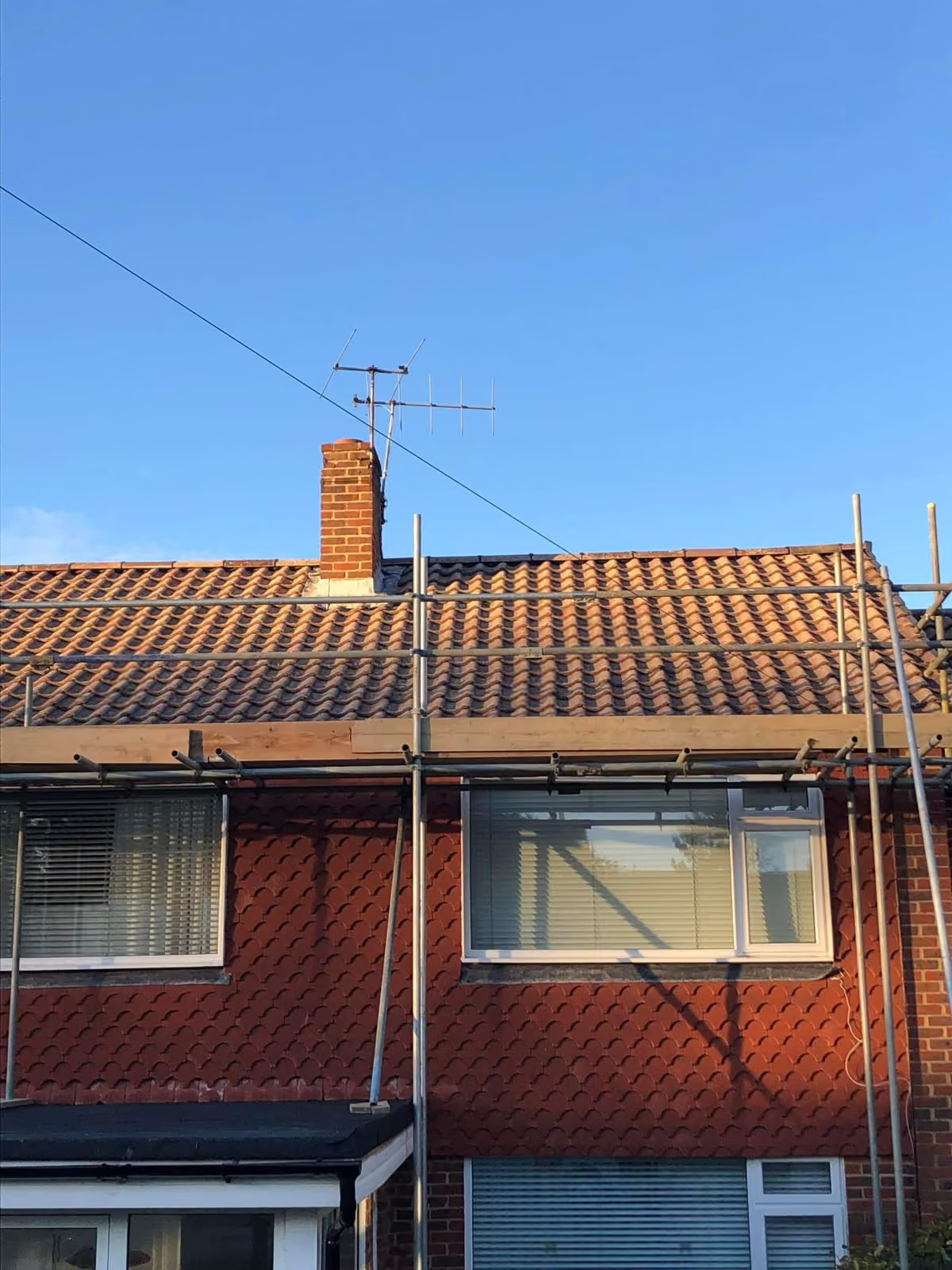
Roof repairs and new roofs in Redhill
Vision Roofing Services is based in Surrey and covers Redhill. Estimates are free, and so is advice on any of the work below. Redhill is a railway town, and the railway is a large part of why its roofs are what they are.
The railway built the town, and chose its roofs
There was almost nothing here before the railway. A settlement grew up after a turnpike road was cut through in 1818, and it was known as Warwick Town. The station opened in July 1841, the junction followed in 1844, and the place took the name Redhill in 1856. Reigate next door is centuries older. Redhill is Victorian, and its roofs show it.
The line did more than build the town. Before it, a roof in this part of Surrey was covered in clay tile, because that is what could be carted to the site. Once the trains were running, Welsh slate came in by the wagon load, and slate was the standard covering on Victorian houses across the south east. So slate and clay tile both turn up on the older Redhill streets, sometimes on the same street.
Redstone Hill, east of the station, is a conservation area of Arts and Crafts villas and early railway cottages, built with timber framing, tile hanging, roughcast and red brick. St John's and Linkfield Street are conservation areas as well, and the church at St John's is listed. On roofs like those, what is allowed to go back on is a question in its own right.
The twentieth century brought concrete tile. Merstham gained a large estate built by the London County Council after the war, set out on a geometric plan across the fields on its east side, so whole streets there are the same age. Whitebushes and Salfords came later, and Watercolour was built on the old Holmethorpe quarry between 2008 and 2012.
The ground splits the town too. Redhill sits in a gap cut through the greensand ridge, while Merstham is north of it, where the land starts rising towards the North Downs. A roof up there takes more wind than one down in the gap.
What usually goes wrong here
A slate roof that comes back in concrete tile
Concrete tile is a great deal heavier than slate. The rafters under a Victorian roof were sized for the weight of slate and nothing more, so swapping one for the other is not a like for like job and the timbers have to be looked at first. In a conservation area there is a second question on top of that, which is what the council will accept going back on. Both are worth settling before anyone orders materials.
The leak is beside the chimney, not in the roof
Victorian houses were built with a fireplace in most rooms, so they carry more chimney stacks than a modern house does. Where a stack passes through the roof it is sealed with lead, called the flashing. Mortar goes soft, the lead lifts at its edge, and water runs down the inside of the stack. It shows as a damp patch on a chimney breast in a bedroom, so people look at the wall and not at the roof.
Every extra shape on a roof is another junction
The bigger houses here do not have one straight pitch. They have wings, gables, dormer windows and bay tops. A valley is the internal angle where two slopes meet, and it is lined with lead. Junctions like that are where a roof lets water in, not the middle of a slope. The more complicated the roof, the more places there are to check, and the longer it takes to find the one that has failed.
Whole streets at Merstham reach the same age together
The estate there went up in one programme after the war, to a repeating layout, so the roofs are the same tile, laid the same year, weathering the same way. Higher ground means more wind on the ridge line and the gable edge. Where those are bedded in mortar the mortar cracks, and once it is loose the wind gets under the edge tiles and lifts them. A dry verge and a dry ridge replace that mortar with fixings, so there is no mortar left up there to fail.
Moss on the shaded side, then a blocked gutter
Redhill Common and Earlswood Common bring mature trees right up to the houses around them, and the shaded side of a roof never fully dries out. Moss builds up under the bottom edge of a slate or a tile and lifts it just enough for rain to track back underneath. What washes off packs down in the gutter, usually at a bend or over the outlet. That is one damp side of one roof causing two separate problems.
What we do in Redhill
- Roof repairs, leaks and slipped tiles
- New roofs and reroofs in tile and slate
- Flat roofs, repaired and replaced
- GRP fibreglass flat roofs
- Dry verge caps, fitted over the gable edge
- Dry ridge systems, fitted over the ridge line
- Fascias, soffits, guttering and downpipes in UPVC
- Gutter cleaning, from £30
- Painting the outside of a house
Nearby towns we also cover
- Roof repairs and new roofs in Reigate
- Roof repairs and new roofs in Dorking
- Roof repairs and new roofs in Crawley
Not sure yet what the roof needs? Our roofing advice answers the questions we get asked most, before anybody comes out to look.
Get an estimate
Roofing work in Redhill
Estimates and advice are free. Ring and describe the problem, or send a photograph of it, and you will get a straight answer about whether it needs a repair or a new roof.
All work guaranteed.
Want us to take a look at the roof?
Leave a name and a number and we will ring back to sort a time. Estimates and advice are free.