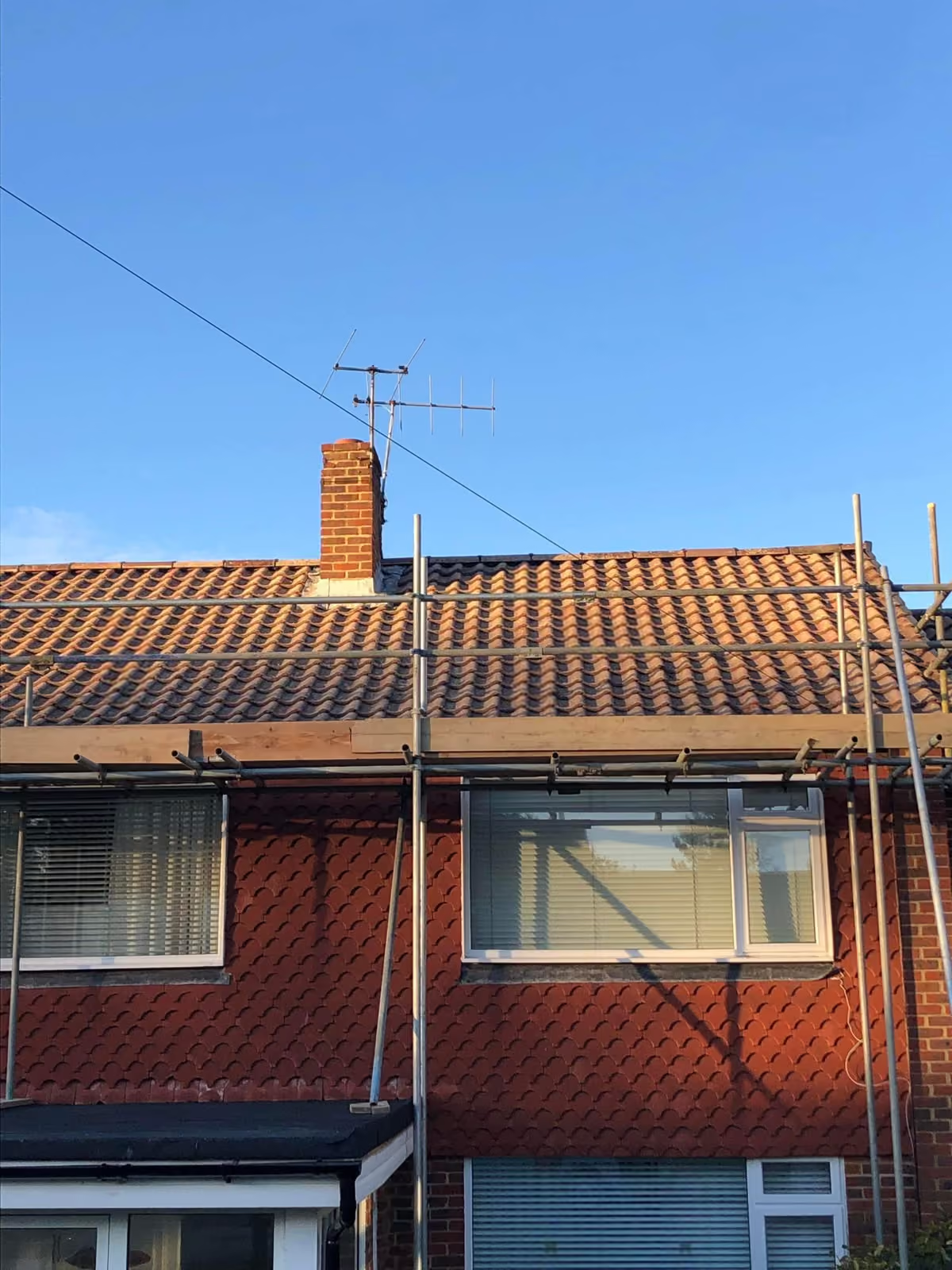
Roof repairs and new roofs in Dorking
Vision Roofing Services covers Dorking, working out of Surrey. The estimate is free and so is the advice. Dorking is an old town sitting in a gap in the hills. Both of those things show up on the roofs.
Clay tile, steep pitches and a town under trees
Dorking sits in the Mole Gap, the place where the River Mole cuts straight through the North Downs. Box Hill is on one side, the greensand hills and Leith Hill on the other, and the Surrey Hills wrap round three sides of the town. The town itself stands on Lower Greensand, with the chalk starting just to the north west. That geology is the reason the roofs here look the way they do.
Clay was dug at North Holmwood from the 1790s and fired into roof tiles, bricks, chimney pots and drain pipes, and that corner of the parish became known as the Potteries. Kilns followed at Stubs Farm in the 1870s, and by the 1920s the Dorking Brick Company stretched from North Holmwood down to Blackbrook. Plenty of the older roofs in this town are covered in tile that was made about two miles away.
The local covering is plain clay tile. It is small, it is laid in double lapped courses, and an ordinary house carries several thousand of them. Pitches are steep, because a plain tile only sheds water on a steep pitch. The oldest buildings in this part of Surrey sometimes carry Horsham stone slabs instead, which are heavy sandstone slates and a trade of their own. Tile hanging, where the same clay tiles are hung down the face of a wall, is a Surrey, Sussex and Kent habit, and there is a lot of it about.
The town grew in layers rather than all at once, so roof age here depends entirely on the street. Rose Hill was the first planned estate, laid out from 1831 and finished by 1861. The railway arrived in 1849, and between 1850 and 1870 Arundel Road, Howard Road and the streets around Tower Hill filled in behind it. The Deepdene and Pippbrook estates were broken up in the 1920s and 1930s, which put Deepdene Vale and Deepdene Park on the map. Council building started at Nower Road in 1920, Chart Downs went up between 1948 and 1952, and Goodwyns followed in the late 1950s and 1960s, its two fourteen storey blocks finished in 1965.
Two things sit on top of all that. The first is trees. Glory Wood comes up to the south east edge of the town, Box Hill is box and yew on the chalk slope opposite, and the older roads have mature trees standing over them. The second is protection. The town centre is a conservation area with more than a hundred listed buildings inside it, along the High Street, West Street, South Street, North Street, Dene Street, Spring Gardens, Cotmandene and Rose Hill, and there are 26 conservation areas across Mole Valley. On a protected roof the covering, the ridge and the mortar can all be part of what is protected.
What usually goes wrong here
Plain tiles drop out one at a time
A plain clay tile is small, and it hangs on a little lug called a nib, or on an oak peg pushed through a hole in the top of the tile. Neither lasts forever. The peg rots, the nib snaps, and a single tile slides out of the middle of an otherwise sound roof. Nothing else moves with it and there is no warning. On a roof carrying several thousand tiles that is a repair rather than a reroof, as long as a matching tile goes back up before the gap starts wetting the batten.
Mortar ridges and verges crack open
The ridge is the line of tiles capping the very top of the roof, and the verge is the sloping edge at the gable end. On most of what went up here from the 1930s onwards, both sit in a bed of sand and cement. The roof moves in the heat and the cold, the mortar does not, and it cracks. Wind then gets underneath and starts lifting. A dry ridge and a dry verge hold the same tiles down with fixings instead, so there is nothing left up there to crumble or repoint. On a listed roof, or one inside the town centre conservation area, that swap is not automatically allowed, so it is worth asking first.
Valleys and flashings on the Victorian roads
Rose Hill, Arundel Road, Howard Road and the streets around Tower Hill are full of houses whose roofs go in several directions at once. Where two slopes meet there is a valley, usually lined with lead. Where the roof meets a chimney there is a flashing, and on the older ones that flashing is a wedge of mortar rather than lead. Mortar in that position cracks and lets water straight down beside the stack. The damp patch then turns up on a bedroom ceiling a fair way from the actual fault, because the water runs along a rafter before it drops.
Gutters fill with what comes off the trees
Glory Wood runs up to the south east edge of the town and the older roads have big trees standing over them. Leaves are only the start of it. They rot down into a wet black silt that sits in the bottom of the gutter, holds moss and never dries out. That silt is heavy enough to pull brackets away from the fascia, and once a gutter has tipped backwards the water goes down the wall instead of down the pipe.
Old mortar does not want cement
Dorking made lime. Chalk was quarried around here from the 1600s, the Dorking Greystone Lime Company opened its Betchworth quarry in 1865, and Dorking lime went into Somerset House and the Bank of England. Closer to home it went into the mortar on ordinary houses. Lime is soft on purpose, because it lets a wall dry out. Repointing an old chimney stack or a parapet in hard sand and cement seals the water in instead, and the brick or the stone starts breaking up behind it. On the older roofs in this town the right answer is usually the one the roof was built with.
What we do in Dorking
- Roof repairs, leaks and slipped tiles
- New roofs and reroofs in tile and slate
- Flat roofs, repaired and replaced
- GRP fibreglass flat roofs
- Dry verge caps, fitted over the gable edge
- Dry ridge systems, fitted over the ridge line
- Fascias, soffits, guttering and downpipes in UPVC
- Gutter cleaning, from £30
- Painting the outside of a house
Nearby towns we also cover
- Roof repairs and new roofs in Reigate
- Roof repairs and new roofs in Redhill
- Roof repairs and new roofs in Horsham
Not sure yet what the roof needs? Our roofing advice answers the questions we get asked most, before anybody comes out to look.
Get an estimate
Roofing work in Dorking
Estimates and advice are free. Ring and describe the problem, or send a photograph of it, and you will get a straight answer about whether it needs a repair or a new roof.
All work guaranteed.
Want us to take a look at the roof?
Leave a name and a number and we will ring back to sort a time. Estimates and advice are free.